Author: Jinhao Wang
I'm Jinhao Wang, Senior Structural Engineer and Technical Director. I hold a master's degree in Civil Engineering, with 18 years of R&D experience in prefabricated modular construction. I am listed as inventor on eight utility patents for expandable container-house structures. I have delivered more than 300 modular building projects for domestic and overseas markets. Nearly all of my actionable insight comes from field deployments, not design manuals. That is how I judge real-world performance for portable modular emergency medical shelter.
Why Emergency Sites Need Modular Medical Capacity
Emergency-response operations put hard demands on field facilities. Every site brings its own geology, logistics and weather. Those constraints decide whether a medical shelter actually functions once deployed.
Different facility solutions suit different jobs. Portable modular emergency medical shelter and mobile modular disaster relief house form one practical option. Factory-prefabricated units ship into the disaster zone. Crews assemble them fast. The output is on-site medical capacity plus accommodation for displaced people.
Field conditions in remote mountain disaster zones are especially unforgiving. Narrow access roads, unstable slopes and erratic weather regularly test the limits of temporary structures. Over the years, I have observed consistent construction challenges across these rugged locations. A recent assignment in Sichuan's mountainous terrain illustrates many of these common hurdles.
Note: This Sichuan-site project delivered civilian residential modular units, not purpose-built medical shelters. All medical-shelter insights below are inferred from analogous harsh-environment construction experience.
Field Evidence from the Sichuan Mountain Site

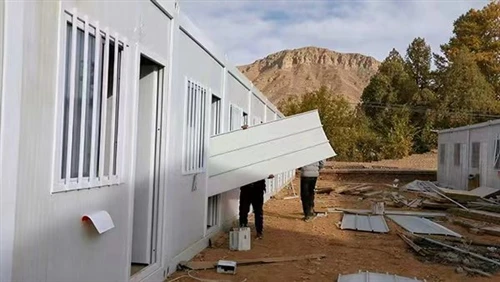
In September 2024 my team built at Longmen Town, Lushan County, Ya'an, Sichuan. The plot sits below a seismically disturbed hillside. Rock there is fractured and overhanging. The households on that slope had already moved out before we arrived, given the geohazard risk. Our brief was temporary modular residential units. Not clinical space. Even so, I mapped every site challenge onto the requirements of a field medical modular unit. Medical applications raise the bar on foundation stability, site safety and utility continuity.
Transport and Access Constraints
Logistics broke first. Persistent rain turned the narrow access lanes to mud. A 9.6-metre truck loaded with wall and roof panels bogged down 1.2 km from the plot. No tow vehicle could reach it. We anchored heavy native timber with ratchet straps. Our second lorry winched the truck free.
After that, every panel, cement sack and aggregate load came 80 m up the slope by hand. The grade is steep. Footing is slippery. Our timeline compressed immediately. Delivery risk like this belongs in pre-deployment planning for an emergency medical modular shelter.
Ground Conditions and Rockfall Risk
Site clearing exposed an abandoned irrigation ditch. It was packed with low-strength silt, unsuitable for foundation bearing. We shifted one row of unit footprints outward by 1.5 m. Then we excavated the silt and backfilled compacted crushed stone.
Further up-slope, our safety team found a basin-sized loose boulder near the ridge crest. Two crew members worked from lanyards. They dislodged it into a designated rock-catchment zone. Geohazard work at this level is critical for medical shelter sites. Unstable ground or rockfall can disrupt triage and patient care.
Concrete Supply, Wind Load and Waterproofing
No ready-mix batching plant operated within practical range. We mixed C20 concrete on-site with spring-sourced mountain water. Low pipeline pressure slowed every pour. Sudden alpine showers damaged fresh concrete surfaces.
Assembly brought its own risk. Strong cross-valley gusts lifted unsecured roof panels. That created real safety exposure for installers. We revised the sequence mid-job. Each panel gets fastened right after positioning. Temporary hold-down strips add wind resistance. Moisture-compromised sealing gaskets stalled the waterproofing. One team member rode a motorbike to a Chengdu warehouse for replacements. Wind loading, waterproofing and material supply all threaten reliable operation of the modular medical shelter on site.
Handover
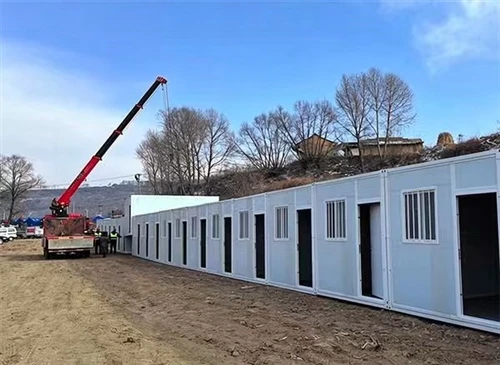
We installed passive rock-fall anchors along the hillside, water distribution lines, emergency lighting and communal sanitation blocks. Fire protection went in complete, including a 2 m³ backup water tank. Six working days later, 21 single-storey units passed joint acceptance inspection. The client's technical team and community representatives all signed off.
What Transfers to Medical Shelter Deployment
Four takeaways carry over to mobile modular disaster relief house and medical-shelter programmes. Mountain transport brings variables you cannot schedule around. Low-bearing ground needs customised foundation treatment. Wind and waterproofing need priority planning, not retrofit. Slope geohazards get resolved before any unit goes in.
The frames are the easy part. Adjust interior layouts. Run purpose-built medical service piping. Fit Class-A fire-rated assemblies. The same modules then work as a functional portable modular emergency medical shelter - triage hubs, observation bays, forward first-aid posts.
Design Lessons That Hold Across Markets
Eighteen years of global delivery taught me one thing. Fast erection alone does not make a dependable medical shelter. Remote mountain-rescue sites stack difficult access on complex geology on volatile weather. Supply-chain gaps and geological hazards need assessment at planning stage. Wind resistance, waterproofing and rock-fall protection belong in core module specifications.
R&D Feedback Loop
Field-validated learnings from Sichuan feed our internal programme directly. Site pain points drive iterative work on universal load-bearing bases, concealed leak-resistant joints and weld-free quick-connect hardware. These refinements are what let a portable modular emergency medical shelter hold clinical function in the chaos of post-disaster rescue, anywhere in the world.