Author: Jinhao Wang
Chief Structural Engineer & Technical Director, licensed structural engineer. Eighteen-year track record in prefabricated modular construction, with over 300 modular housing projects delivered globally.
Product literature often presents a heat insulated emergency shelter for hot disaster area as a straightforward fix: specify high-performance thermal panels, ship modules to site, bolt components together, and call the job complete. Field reality is messier. In tropical and subtropical disaster zones you rarely get a flat, dry, well-drained plot. You get daytime heat, air that sits near saturation, and ground that never fully dries out. Insulation only starts working once all three are handled, and handling them is the part drawings tend to skip. I met that problem head-on at Youling Yao Village in Guangdong, southern China.
The Site at Youling Yao Village
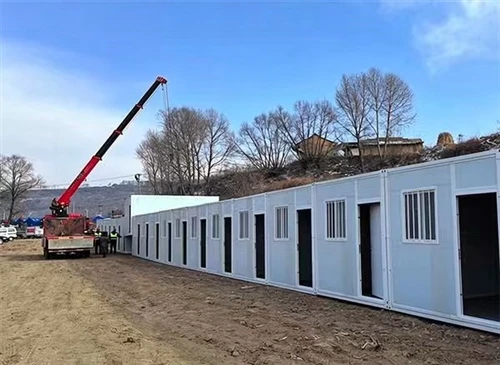
My team mobilised on 12 April 2024. The site sat on the periphery of a steep mountain-top Yao community, regularly exposed to flash flooding and slope failures during wet seasons. Before this build, residents could only take refuge inside a small community hall once flood alerts were issued, and evacuation posed tangible barriers for elderly people and those with limited mobility. Our brief covered 25 thermally optimised light-steel flat-pack shelters, plus communal kitchen amenities, restrooms, water storage and emergency lighting. Full handover had to be finalised by 8 May - only 27 working days on-site.
Access Constraints That Reshape Rapid Deployment
Industry conferences frequently highlight the advantages of rapid deploy modular disaster housing. Modular logic does compress on-site construction timelines. What those slides never cover is what a mountain village does to your logistics.
Heritage Stone Trails, No Crane
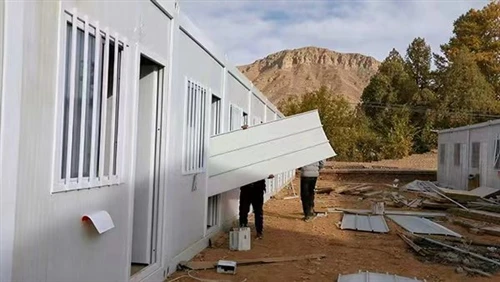
Access relied on stone-paved heritage trails narrowing to 1.8 metres. Cranes and large delivery trucks could not reach the worksite at all. We off-loaded every building assembly outside the village perimeter, moved materials part-way uphill on small four-wheel-drive vehicles, then manoeuvred components by hand along the final steep 300-metre stretch.
One Panel, One Lesson
During a supply run, a six-metre thermal sandwich panel collided with exposed granite bedrock. The impact dented its outer cladding and fractured the insulating core. In this persistently warm, damp microclimate, water ingress through that damaged section would erode thermal resistance, so we declined to fit it and arranged a replacement shipment. Module assembly slipped by two days. Immediately afterwards my team fabricated wooden corner protectors for every panel, and a crew member walked ahead of each convoy to clear sharp rock protrusions. Properly manufactured components still carry handling risk on a route like this.
Sealing Work in 95 Percent Humidity
Heat and humidity guided nearly every technical decision on this heat insulated emergency shelter for hot disaster area. Daytime temperatures climbed steadily while sunshine and sudden downpours alternated with minimal warning. During seasonal humid spells, readings exceeded 95 percent, leaving continuous condensation across steel panel surfaces. Some of the crew wanted to hold the original sealing timeline and recover the lost days. I stopped that. Sealant cannot make a durable, water-tight, thermally efficient joint over damp metal, and poor adhesion leaves gaps that dismantle insulation performance over the years.
A Slower Sequence That Protected the Envelope
Sealing work was not to start before 9 a.m. Crews ran blowers until surface condensation had fully evaporated, and joint sealant went on only once panels were thoroughly dry. Staff then monitored fresh joints for four hours, shielding uncured compound from dew and unexpected rain.
Ground Moisture and the Thermal Envelope
Thermal reliability also depended on moisture below the floor. Rather than grade large sections of hillside, which would risk slope instability, we built independent strip foundations following existing contours. Filter-stone layers and moisture-proof base pads handled seasonal underground seepage and stopped ground damp migrating up into wall assemblies. High-performance flame-retardant panels formed the envelope against sustained high ambient temperatures.
Slope Stability Alongside Shelter Function
Loose weathered soil lay directly behind our work area, and light rainfall could dislodge debris. We installed flexible slope-restraint nets, deepened intercept drains and stacked sandbags at the slope toe. Each morning, before any module went up, two crew members ran slope checks and cleared blocked drains.
Facilities Shaped by Local Living Patterns
Supporting infrastructure followed local habits rather than a generic template. The communal kitchen kept self-cooking work surfaces so families could feed themselves during emergencies. Restrooms took anti-seepage membranes and extra ventilation against muggy air. A spring-fed reservoir with rain-harvesting inlets secured water, backed by generator lighting. The central open area doubled as assembly zone and gathering space.
At practical completion the handover inspection ran jointly with the families who would move in: they walked every unit with us, together with the village elders. Yao elders touring the site said the layout made flood-time evacuation far more workable for older residents than the old community hall.
What This Project Changed in My Practice
This assignment sharpened my understanding of the real-world advantages of rapid deploy modular disaster housing in hot-hazard zones. Fast erection delivers limited value without field-level adjustment centred on heat-humidity control: handling protocols for damaged-route transit, daily slope oversight, and sealing sequences rebuilt around heavy condensation. Insulation performance is never settled by datasheets alone; moisture management on site preserves or destroys it.
I have delivered shelters across hot-desert, humid coastal and high-rain tropical geographies, and my principle has not moved: safety first, climate-driven engineering. Off-the-shelf kits rarely hold consistent high-temperature performance. Detail aligned to local heat-humidity reality, plus respect for how a community actually lives, is what makes a shelter fit for purpose in these contexts.
Working Through a Similar Site?
If you are scoping an emergency shelter programme in a hot-humid region with tight access or unstable ground, the useful conversation is sequencing, not panel specifications. Send me your site constraints - access route, slope condition, humidity pattern - and I will tell you where the thermal envelope is likely to fail first, and what to change in the build order before mobilisation.